
05 November 2026
Batteries are coming for Europe’s gas plants
By Alexandru Mustață and Ana Afonso Silva
Europe’s gas expansion plans are getting a reality check. Rising construction costs, permitting disputes and grid connection delays are making new gas power plants increasingly difficult and expensive to build. Since 2023, cancelled gas power capacity has doubled to 20.6 GW–equivalent to a third of Europe’s planned gas capacity. Meanwhile, clean flexibility solutions to balance the grid are advancing.
Developers know it too. The same developers planning to build gas plants are now turning to battery storage. From Belgium to Italy and Romania, energy companies are rethinking their investments as batteries become an attractive way to provide the flexibility and grid stability that Europe’s electricity system needs. Batteries can store surplus renewable electricity for times of peak demand, without the fuel price exposure of gas plants.
Seeing the risks of gas first hand has pushed developers to switch to batteries. Gas produces carbon emissions, exposes consumers to volatile fossil fuel markets and keeps countries dependent on imports. But this is not the only way to ensure stability and meet electricity demand, having at hand the combo of renewables and clean flexibility. Still, governments continue to shape policies around yesterday’s fossil fuels.
Germany makes the case. As a result of its first capacity auction in November 2026, the German government will spend 12 billion euros in public subsidies over 15 years on new gas capacity. This is Europe’s most expensive power capacity mechanism yet, and it is only the first of two auctions for 4.5 GW of new capacity. The scheme, approved by the European Commission, gives gas plants an advantage over batteries and other clean alternatives.
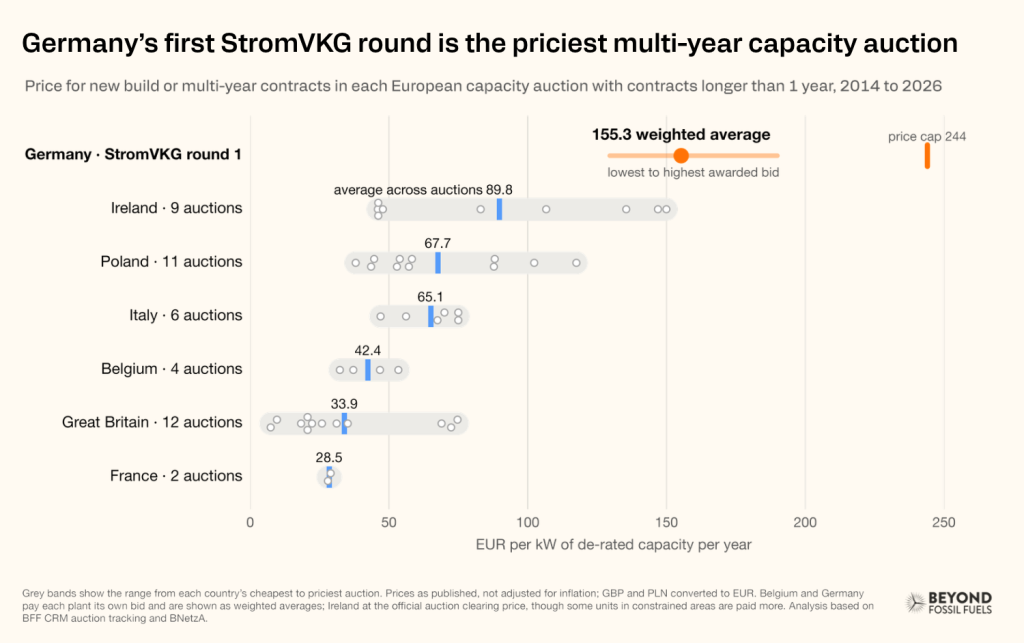
Link to data sheet
The consequences could last for years. Consumers will be locked into 15 years of subsidies for new gas infrastructure, paying for plants that may become increasingly expensive to operate as fuel prices fluctuate.
There’s a new wave of gas cancellations already happening across Europe, with projects in several countries showing how competitive battery storage is challenging the case for new gas.
Belgium: Why are gas projects a risky bet?
Energy developer Luminus has faced challenges with two gas power projects in Belgium: Ringvaart and Seraing. At Ringvaart, Luminus planned to add 235 MW of gas-fired capacity but the expansion faced legal challenges over its environmental permit. A few years later, they applied for a battery storage project in place of the gas expansion, to help meet the growing need for flexibility and stability on the electricity grid.
Meanwhile, countless delays from construction and grid connection problems at the Seraing gas plant could potentially cost Luminus tens of millions of euros.
Italy: The failed promise of the coal-to-gas switch
Italy is a clear example of why Europe’s coal-to-gas strategy is out of line with the energy transition.
The country’s largest utility, Enel, cancelled two coal-to-gas projects, Brindisi Sud and La Spezia, citing lack of need, changing market conditions and poor economics, alongside local environmental opposition. Instead, it is turning both sites into battery storage.
Italy’s capacity market restrictions on battery participation prevent storage projects from competing on equal terms for public subsidies, while gas continues to benefit from consumer money. Italy has an opportunity to lower its energy bills and reduce its gas dependence by creating an even playing field.
Romania: Rising costs for gas make batteries more attractive
Romania’s energy crisis has highlighted the risks of relying on gas to replace coal power, as battery storage is developing much faster and providing crucial grid flexibility. The country’s main state-owned coal operator planned to replace ageing coal plants with two gas power stations: a 475 MW plant at Turceni and an 850 MW plant at Ișalnița. Both were allocated funding from the EU Modernisation Fund in 2022. Neither has been built.
The Ișalnița gas project was cancelled after repeated failed tenders and rising costs. Instead, the company now plans to build 1 GW of battery storage across Ișalnița, Turceni and Rovinari. Meanwhile, Romania’s battery storage capacity grew from zero projects in 2024 to 1,162 MW (2,312 MWh) by October 2026. Faster project development, alongside simplified licensing and grid connection procedures, means the country’s 1.2 GW battery storage target for 2030 is likely to be exceeded by the end of 2026.
UK: Climate policy puts batteries first
The UK shows that when climate policy supports clean technologies, developers have more reason to invest in them. Although EDF was initially considering a gas plant at West Burton C, now Fidra Energy is building battery storage with a 15-year capacity market contract on the same site. The project is expected to have fewer environmental impacts and support the UK’s net-zero targets. InterGen also moved away from its original plan for the 1,199 MW Gateway Energy Centre gas power station, opting instead for battery storage to help balance renewable electricity and support grid stability.
These examples show that batteries can help keep the grid stable without burning gas or being exposed to volatile fuel prices. But for more battery projects to move forward, developers need clear policies that don’t exclude batteries and create faster grid connections.
Why are governments still backing gas?
The cases from Belgium, Italy, Romania and the UK show that gas project plans are often delayed or abandoned as costs, permitting conditions and electricity markets change.
Governments are undermining this progress by designing capacity markets that favour gas over clean flexibility. These markets should reward clean technologies for delivering the services the electricity system actually needs, not provide decades of public support for fossil fuel infrastructure. The European Commission should ensure that capacity mechanisms comply with EU rules, rather than diverting public money into new gas plants.
Europe does not need to replace its dependence on coal with another fossil fuel. It needs an electricity system powered by affordable renewables, complemented by storage and supported by a smarter, more flexible grid.